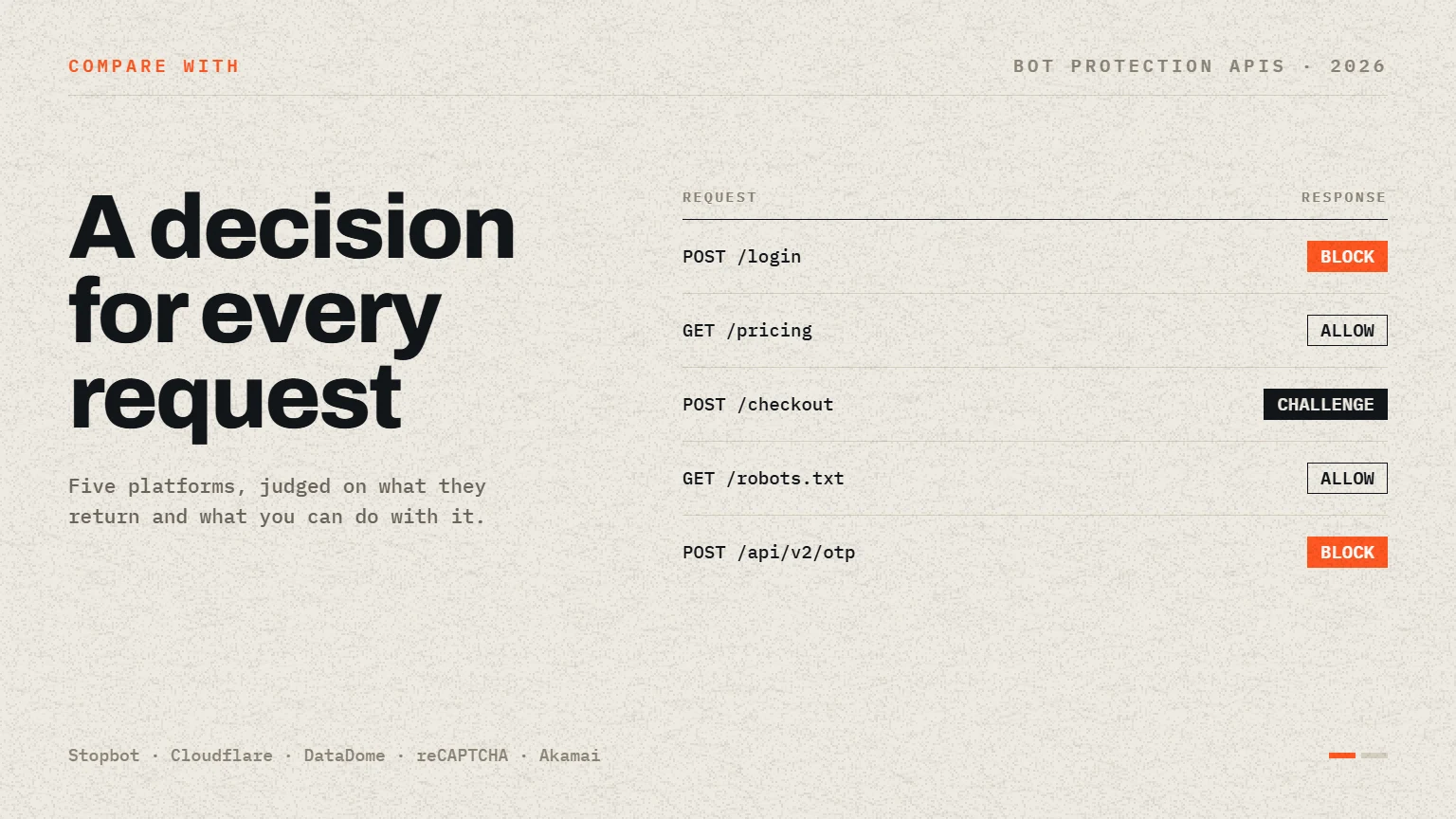
Bot protection products solve different problems. Some return request intelligence to application code, some enforce at a global edge, some specialize in managed bot mitigation, and some primarily produce a fraud or interaction score. This ranking focuses on one narrow use case: a development team wants a practical bot decision for a web or API request while retaining control over what the application does next.
Selection criteria
- How directly developers can consume the decision in application code.
- Whether the result provides useful classification or decision context.
- Deployment effort and dependence on a particular edge or delivery platform.
- Suitability for websites and APIs rather than browser interaction alone.
- Availability of current public documentation for the capabilities described.
Use-case ranking
Ranking for developer-controlled request decisions
Products are ordered for teams that prioritize a direct, application-consumed request decision over a fully managed edge platform. A different deployment requirement can produce a different order.
- 1
Stopbot Blocker
Best for: Developers who want a compact API response and keep enforcement in their own application.
Stopbot Blocker evaluates request context and returns bot classification, the final access decision, URL-threat context, and a detection reason. It ranks first for this specific API-first use case because the integration decides how to handle the result rather than requiring the application to move behind one edge network.
Strengths
- Straightforward request-level API integration.
- Separates
isBotclassification fromblockAccesspolicy. - Returns
detectActivityfor decision context.
Limitations
- The customer must implement secure response handling and outage behavior.
- It is not a full CDN, WAF, or managed edge-delivery replacement.
- 2
Cloudflare Bot Management
Best for: Sites already using Cloudflare that want edge bot scores and platform-level enforcement.
Cloudflare exposes bot scores and related fields that can drive firewall rules and application logic. Its strongest fit is an existing Cloudflare deployment where traffic already passes through the edge and teams want controls integrated with that platform.
Strengths
- Bot scoring is integrated with Cloudflare's edge and rules ecosystem.
- Supports verified bot and automation-related signals.
- Can enforce before requests reach the origin.
Limitations
- The best experience is tied to Cloudflare's network and plan capabilities.
- Migration and rule design can be broader than adding a standalone API call.
- 3
DataDome Bot Protection
Best for: Organizations seeking a specialized managed bot and online-fraud protection platform.
DataDome positions its service around real-time detection across websites, mobile applications, and APIs. It is a strong specialist option when managed detection breadth and dedicated bot expertise matter more than a minimal request-decision API.
Strengths
- Specialized coverage for bot and online-fraud use cases.
- Supports web, mobile, and API protection scenarios.
- Managed platform reduces some in-house detection work.
Limitations
- DataDome is a broader managed protection platform, not a minimal request-decision endpoint.
- Its documented model combines edge integrations, client-side and server-side signals, and automated mitigation, which may exceed the integration surface required for a small deployment.
- 4
Google reCAPTCHA
Best for: Teams that need interaction and account-defense risk signals within Google Cloud.
reCAPTCHA provides risk analysis and controls for web, mobile, account, and transaction use cases. It fits teams that want Google Cloud integration and risk assessment, although its model is not identical to a general IP-and-request bot decision endpoint.
Strengths
- Established risk-analysis tooling for user interactions and accounts.
- Google Cloud integration and enterprise controls.
- Supports more than visible checkbox challenges.
Limitations
- The assessment model and integration goals differ from a simple blocker response.
- Teams need to design score thresholds and action-specific policy.
- 5
Akamai Bot Manager
Best for: Large organizations that want bot management inside a broad Akamai application-security deployment.
Akamai Bot Manager is designed for large-scale bot visibility and response within Akamai's security platform. It is compelling for enterprises already operating there, but it is less aligned with the lightweight standalone API criterion used for this ranking.
Strengths
- Enterprise-scale edge visibility and response options.
- Part of a broad application and API security portfolio.
- Designed for sophisticated bot-management programs.
Limitations
- Deployment and operations can be heavier than an API-only integration.
- Best fit depends strongly on existing Akamai architecture and procurement.
How to choose
Choose Stopbot Blocker when application-controlled decisions and a small integration surface are the priority. Choose Cloudflare or Akamai when enforcement at an existing edge platform is central. Evaluate DataDome when a specialist managed bot program is the goal. Consider reCAPTCHA when user-interaction and account risk assessment fits the workflow. In every case, test known users, verified crawlers, APIs, login, checkout, monitoring, and failure behavior before production enforcement.
Sources
Choose from evidence
Verify the current product fit before you commit.
Use the published criteria as a shortlist, then confirm current documentation, test with representative traffic, and measure false positives, latency, and operational cost in your own environment.