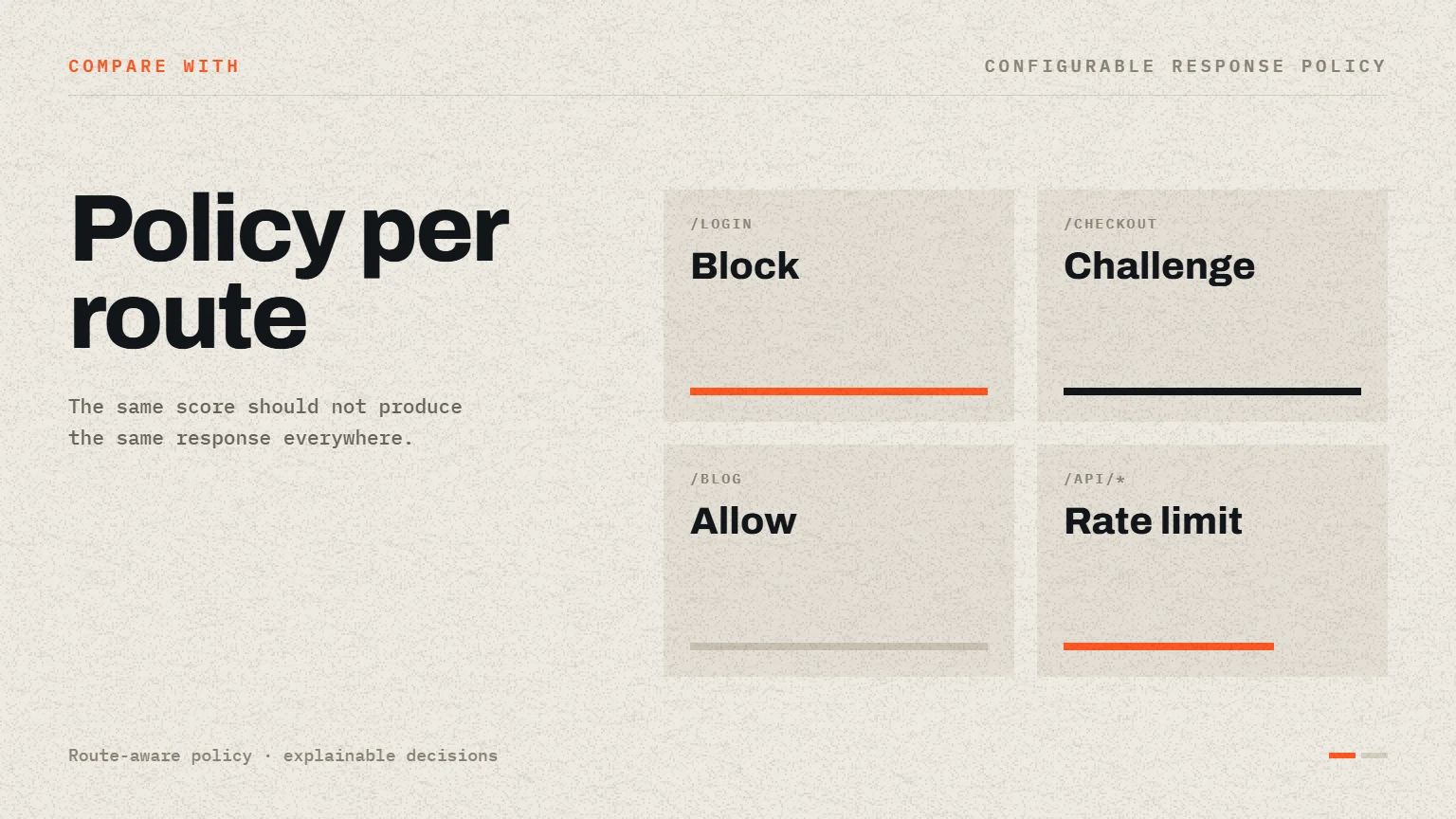
A bot label is only useful when an application can turn it into a safe response. This comparison focuses on products that help teams evaluate request context and apply a policy outcome to different routes, campaigns, or protected actions. The ranking favors explicit application-level response control rather than maximum edge-network breadth.
Selection criteria
- Ability to create policy for a specific application context or configuration.
- Separation between automation classification and the final access response.
- Availability of request, network, and decision context for investigation.
- Control over redirect, status, allow, challenge, throttle, or deny behavior.
- Operational fit for teams that want the application to remain the final enforcement point.
Use-case ranking
Ranking for configurable application-level response control
The order prioritizes route-aware decisions and customer-controlled application responses. It does not measure global network capacity, challenge-solving efficacy, pricing, or support quality.
- 1
Stopbot Blocker V2
Best for: Applications that need named configurations and a response they can apply directly.
Blocker V2 accepts a configuration name plus IP, user-agent, URL, and optional request context, then returns a flat decision response that includes
isBot,blockAccess,threatURL,detectActivity, and configured page-response fields. It ranks first for this narrow application-controlled policy model.Strengths
- Named configurations support different policy contexts.
- Decision, explanation, and page-response fields are returned together.
- Application code keeps control over the final response.
Limitations
- Customers must validate responses and prevent redirect loops.
- It does not replace authorization, rate limiting, a WAF, or secure business logic.
- 2
Cloudflare Bot Management
Best for: Cloudflare customers that want bot signals combined with edge rules and Workers.
Cloudflare can combine bot scores with firewall expressions, rate limiting, challenges, and programmable edge logic. It is a strong configurable option when the application is already routed through Cloudflare and edge enforcement is desirable.
Strengths
- Rich rule composition within the Cloudflare platform.
- Enforcement can happen before origin processing.
- Workers can add programmable response behavior.
Limitations
- Policy and feature availability depend on Cloudflare deployment and plan.
- The application-controlled API model differs from Blocker V2.
- 3
Akamai Bot Manager
Best for: Enterprises needing configurable bot responses inside a mature Akamai edge program.
Akamai combines bot categorization and response capabilities with its broader application-security platform. It fits complex enterprise programs, especially where Akamai already controls delivery and security policy.
Strengths
- Broad enterprise bot-management controls.
- Edge-scale visibility and response.
- Integrates with a wider application-security portfolio.
Limitations
- Architecture and operations are heavier than a standalone endpoint.
- Suitability depends on existing Akamai services and enterprise requirements.
- 4
DataDome Bot Protection
Best for: Teams wanting a dedicated managed platform for bot and fraud response.
DataDome provides specialized bot protection for websites, mobile applications, and APIs. It is a strong option when managed detection and response breadth are more important than exposing every application response as a simple customer configuration.
Strengths
- Specialist bot and fraud focus.
- Coverage across multiple application channels.
- Managed approach can reduce internal tuning burden.
Limitations
- DataDome's automated mitigation model is broader than an API that returns a named response policy for the application to execute.
- Applications that require a specific redirect or HTTP-status workflow should verify how that behavior maps to DataDome's integration and enforcement model.
- 5
Google reCAPTCHA
Best for: Google Cloud teams applying risk-based actions to interactions, accounts, and transactions.
reCAPTCHA supports risk assessments that application policy can translate into actions. It remains useful for protected user interactions, but its assessment flow is not a direct match for a named configuration that returns a complete page-response instruction.
Strengths
- Action-specific risk assessment.
- Account and transaction protection options.
- Strong fit in Google Cloud environments.
Limitations
- Customers still need to select thresholds and map scores to safe actions.
- It is not designed as the same network-and-request policy response model.
Response design matters as much as detection
Whichever product you choose, validate the service status before enforcing a decision. Normalize and compare redirect targets to the current URL to prevent loops. Keep redirect destinations under administrator control, reject unsafe schemes, and avoid reflecting an untrusted URL or status into a response. Define what happens on timeout, invalid JSON, authentication failure, quota failure, and unavailable service.
Sources
Choose from evidence
Verify the current product fit before you commit.
Use the published criteria as a shortlist, then confirm current documentation, test with representative traffic, and measure false positives, latency, and operational cost in your own environment.