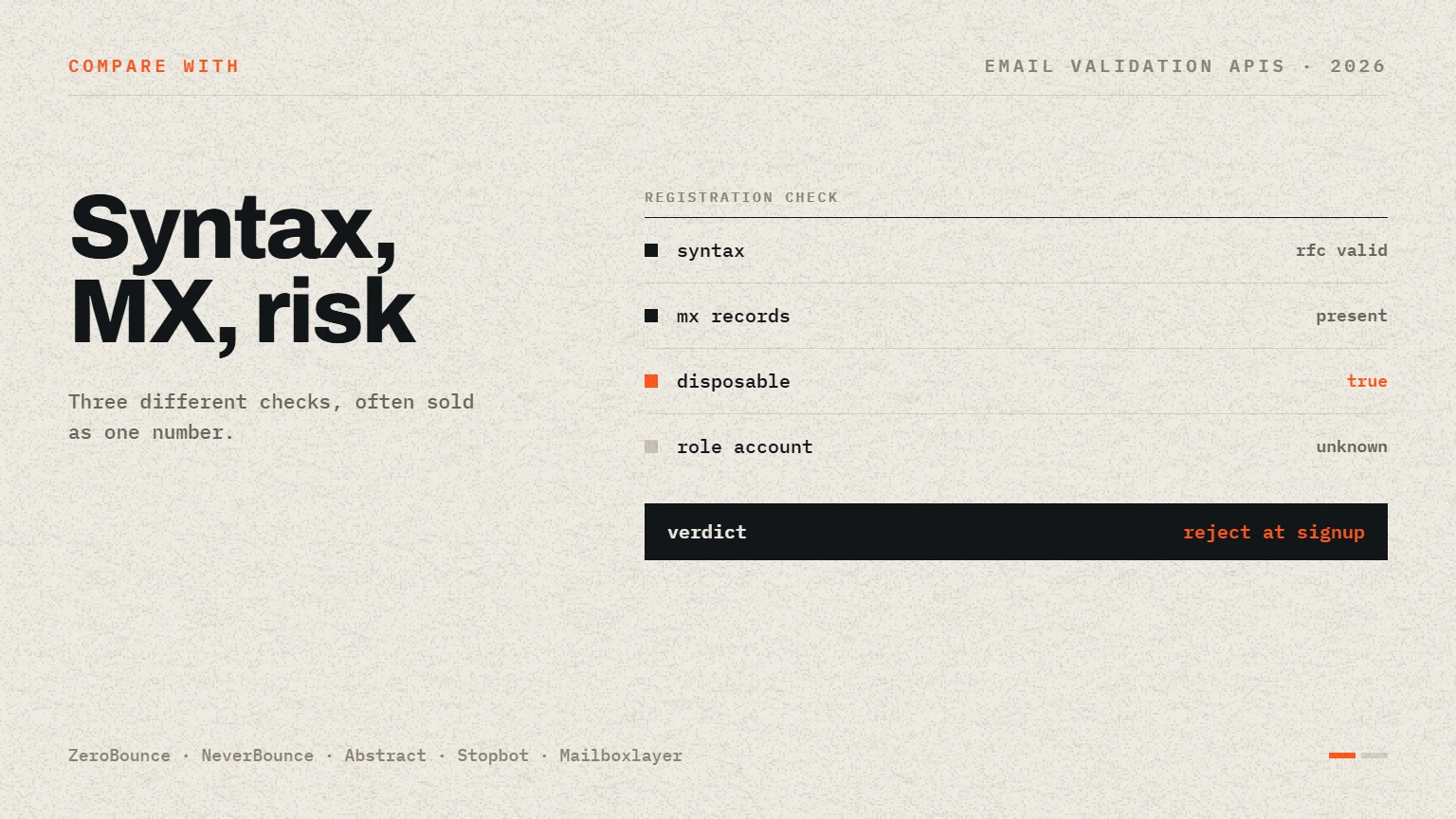
Email validation APIs can improve form quality and reduce obvious delivery failures, but they do not all answer the same question. Some specialize in deliverability and list cleaning, while others expose domain and DNS signals that application developers can evaluate. This ranking focuses on registration-time validation and data-quality workflows, not a private benchmark of inbox placement or mailbox ownership.
Selection criteria
- Breadth of documented email-quality and deliverability signals.
- Suitability for synchronous registration checks and list-cleaning workflows.
- Clarity of API documentation and returned result categories.
- Availability of domain, disposable-address, and mail-system context.
- Operational maturity for teams that need repeatable validation at scale.
Use-case ranking
Ranking for email data quality and registration checks
The order favors mature specialist validation platforms and clearly documented validation signals. Stopbot is ranked for teams that value DNS and disposable-domain context within the Stopbot API family; it is not presented as a mailbox-ownership or guaranteed-deliverability service.
- 1
ZeroBounce
Best for: Organizations needing a mature specialist platform for email validation and list hygiene.
ZeroBounce documents a validation API with detailed status and sub-status results for deliverability-oriented workflows. Its specialist focus and supporting data-quality services make it a strong general choice for organizations maintaining email lists.
Strengths
- Detailed documented result taxonomy.
- Designed for both individual checks and broader list-quality workflows.
- Established focus on email data quality.
Limitations
- Result categories still cannot guarantee future delivery or engagement.
- Teams should review data handling, plan limits, and latency for their workload.
- 2
NeverBounce
Best for: Teams prioritizing a dedicated email verification workflow and documented result handling.
NeverBounce provides verification endpoints and guidance for interpreting verification results. It is well suited to teams that want a specialist service for point-of-entry validation or list cleaning without building mail-domain checks themselves.
Strengths
- Dedicated verification product and developer documentation.
- Supports common real-time and list-quality use cases.
- Clear workflow for consuming verification results.
Limitations
- A valid result is not proof that the person submitting the address owns it.
- Customers should test ambiguous and catch-all domains in their own policy.
- 3
Abstract Email Validation API
Best for: Developers wanting a straightforward hosted validation API with a quick setup path.
Abstract packages common syntax, domain, and deliverability-oriented checks behind a developer-friendly API. It is a practical option for forms and account workflows where ease of integration matters more than a large email-data platform.
Strengths
- Simple hosted API integration.
- Combines common email-quality checks in one response.
- Accessible fit for application developers.
Limitations
- Specialist list-management depth may be narrower than dedicated providers.
- Current fields and plan limits should be verified before implementation.
- 4
Stopbot Email Validation
Best for: Stopbot customers needing syntax, disposable-domain, MX, SPF, and DMARC context through the same API account.
Stopbot Email Validation returns parsed email information together with disposable-domain, MX, SPF, and DMARC results. It fits security and registration workflows that need transparent domain-level signals alongside other Stopbot services.
Strengths
- Exposes useful domain and DNS authentication context.
- Uses the same account and authentication model as other Stopbot APIs.
- Suitable for application-controlled acceptance policies.
Limitations
- It does not prove mailbox ownership or guarantee message delivery.
- DNS records describe the domain configuration, not the intent of the person entering an address.
- 5
Mailboxlayer
Best for: Developers seeking a hosted email validation endpoint in the APILayer ecosystem.
Mailboxlayer provides syntax, domain, MX, and related validation signals through a hosted API. It can be a convenient fit for applications already using APILayer products or requiring a compact verification integration.
Strengths
- Hosted API with common email validation signals.
- Straightforward integration model.
- Part of a broader API marketplace.
Limitations
- Mailboxlayer combines SMTP checks, quality scores, typo suggestions, disposable-provider detection, and catch-all indicators, but those signals do not prove mailbox ownership.
- Teams still need an application policy for catch-all, role-based, and otherwise inconclusive results.
Validation is not ownership verification
Syntax, MX, disposable-domain, SPF, DMARC, and mailbox signals can improve data quality, but none prove that the visitor controls the address. Use a confirmation email or one-time link when ownership matters. Preserve an explicit fallback for temporary DNS failures, catch-all domains, and provider timeouts so a validation dependency does not silently lock out legitimate users.
Sources
Choose from evidence
Verify the current product fit before you commit.
Use the published criteria as a shortlist, then confirm current documentation, test with representative traffic, and measure false positives, latency, and operational cost in your own environment.