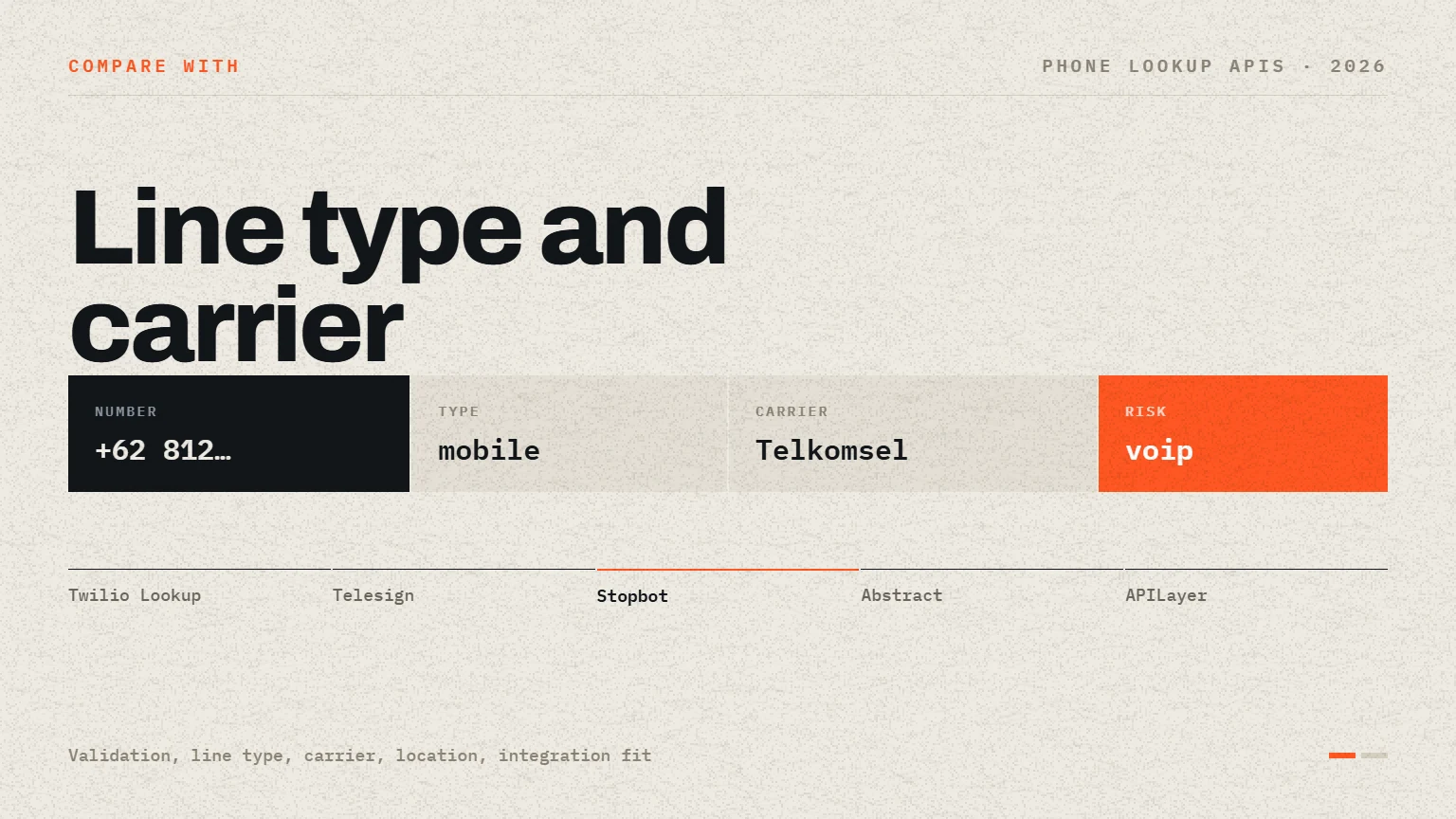
Phone lookup APIs range from basic number parsing to broad identity, reachability, routing, and fraud signals. This ranking focuses on developer access to number validity, formatting, line type, carrier, country, and location context. It does not benchmark live reachability across countries and does not treat a valid number as proof of ownership.
Selection criteria
- Breadth of documented phone intelligence and validation fields.
- Support for line type, carrier, country, and formatting context.
- Developer documentation and ease of synchronous API integration.
- Suitability for international account, communications, and risk workflows.
- Clarity about optional packages, regional coverage, and signal limitations.
Use-case ranking
Ranking for phone number intelligence
The ranking favors mature global lookup platforms with documented intelligence options. Stopbot ranks as a practical compact endpoint for core fields, not as a replacement for every identity, SIM, reachability, or fraud product offered by specialist telecommunications providers.
- 1
Twilio Lookup
Best for: Organizations needing a mature phone intelligence platform with optional data packages.
Twilio Lookup documents phone formatting and validation together with optional line-type and other intelligence packages. Its communications ecosystem and breadth make it a strong general choice when phone lookup is part of messaging, onboarding, or fraud controls.
Strengths
- Mature global communications and lookup platform.
- Multiple documented intelligence packages.
- Strong fit with messaging and verification workflows.
Limitations
- Data packages and pricing must be selected for the required fields.
- A successful lookup does not establish that the current user owns the number.
- 2
Telesign Phone ID
Best for: Risk and identity teams seeking broad phone-derived attributes and scoring options.
Telesign Phone ID is positioned around phone intelligence for identity and risk decisions. It is a strong fit when an organization needs more than formatting and carrier data and can integrate a broader telecommunications risk platform.
Strengths
- Phone intelligence is designed for identity and risk workflows.
- Broad product context beyond basic number parsing.
- Suitable for global enterprise use cases.
Limitations
- The broader platform can exceed the needs of a simple lookup endpoint.
- Available attributes and commercial access should be confirmed by region.
- 3
Stopbot Phone Number Identify
Best for: Stopbot customers wanting normalized number, type, carrier, location, and country information through one compact API.
Stopbot Phone Number Identify validates international number structure and returns normalized phone information, number type, carrier, location, and country code. It fits application teams that need core number context alongside Stopbot traffic and validation services.
Strengths
- Compact response for common number-intelligence fields.
- Uses the same authentication model as other Stopbot APIs.
- Useful for normalization and application-controlled validation.
Limitations
- It does not prove number ownership or current reachability.
- Carrier and location data can be affected by portability and regional data availability.
- 4
Abstract Phone Validation API
Best for: Developers wanting a simple hosted API for common validation and carrier fields.
Abstract offers a developer-friendly phone validation API for common number, country, carrier, and line-type information. It is a practical option for forms and application workflows that value a straightforward integration.
Strengths
- Simple hosted API workflow.
- Covers common validation and number-context needs.
- Accessible for lightweight application integrations.
Limitations
- Specialist identity and fraud depth may be narrower than telecommunications platforms.
- Teams should verify current country coverage and response fields.
- 5
APILayer Number Verification API
Best for: Applications already using the APILayer marketplace and needing basic number verification.
APILayer provides a hosted number verification product for common validity, format, country, carrier, and line-type use cases. It can be convenient for teams that prefer a marketplace API and a compact integration surface.
Strengths
- Straightforward hosted endpoint.
- Common number and carrier context in one integration.
- Fits the broader APILayer API marketplace.
Limitations
- The documented response focuses on format, country, location, carrier, and line type rather than an ownership challenge or consent record.
- Applications that need reachability or user-ownership confirmation require an additional verification step.
A valid number is not a verified user
Number structure, type, carrier, and location are useful context, but they do not prove who controls the number. Mobile number portability can also make carrier fields historical or approximate. Use an OTP or another possession challenge when ownership matters, obtain appropriate consent before messaging, and apply regional communications and privacy requirements.
Sources
Choose from evidence
Verify the current product fit before you commit.
Use the published criteria as a shortlist, then confirm current documentation, test with representative traffic, and measure false positives, latency, and operational cost in your own environment.