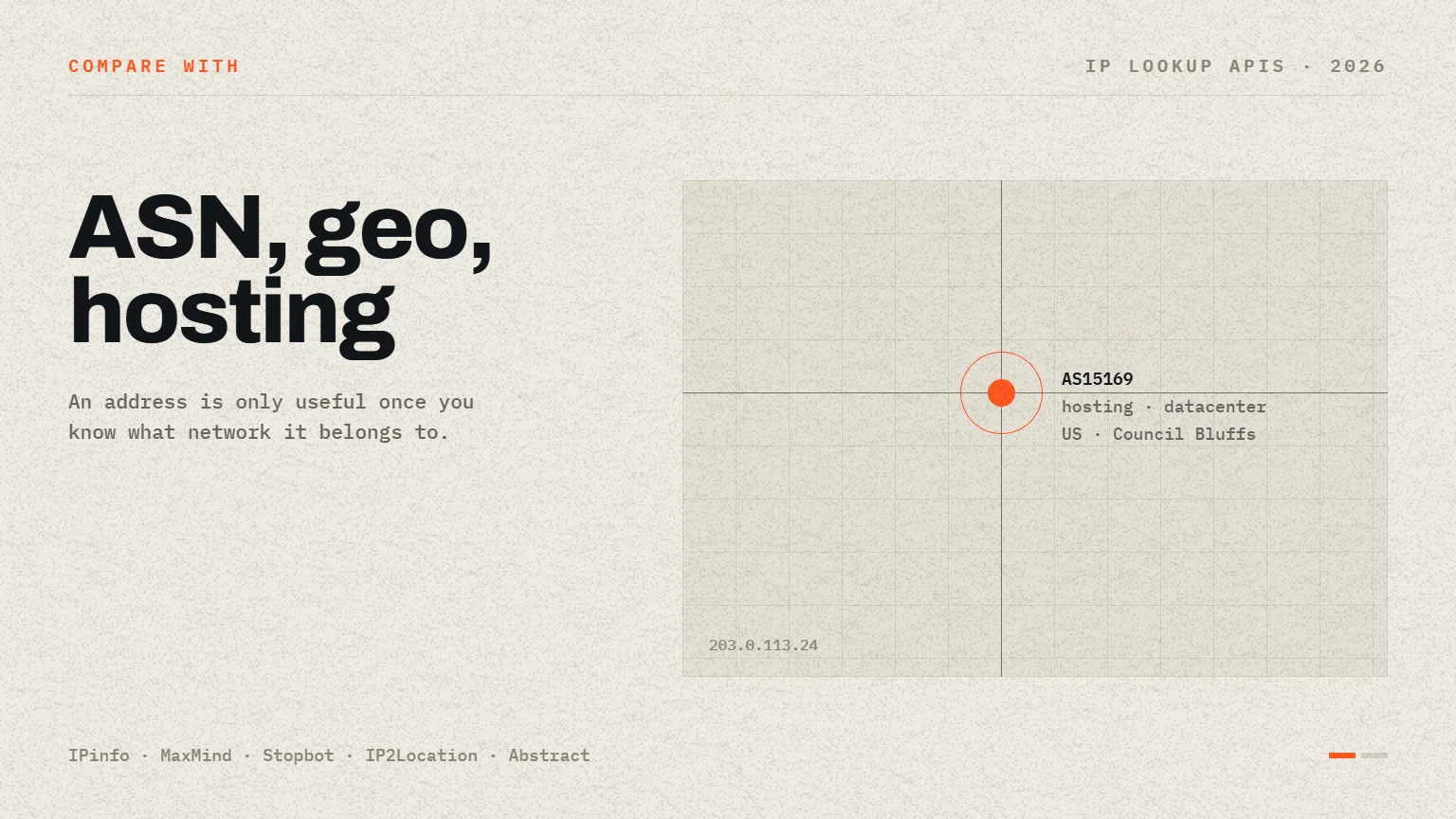
IP lookup APIs enrich an address with approximate geography and network ownership, but their depth, update model, and intended use differ. This ranking covers broad network and geolocation context for application development. It does not test precision against a private ground-truth location set and does not rank fraud scores, VPN detection, or downloadable database licensing.
Selection criteria
- Breadth of geolocation, ASN, organization, and network fields.
- Clarity of developer documentation and integration options.
- Product maturity for general IP intelligence use cases.
- Ability to distinguish useful network context such as hosting or connection type.
- Transparency about the role and limitations of IP-derived data.
Use-case ranking
Ranking for broad IP intelligence
The ranking favors established, well-documented datasets and broad IP context. Stopbot ranks strongly for teams already using its security API, but the comparison does not claim it has the broadest standalone data portfolio.
- 1
IPinfo
Best for: Teams needing a broad IP data platform with multiple specialized datasets.
IPinfo documents geolocation, ASN, company, privacy, carrier, and other IP datasets through APIs and downloadable products. It ranks first for broad standalone IP intelligence and flexible data depth.
Strengths
- Wide selection of IP intelligence datasets.
- Developer-oriented APIs and database options.
- Suitable for enrichment beyond basic country lookup.
Limitations
- Teams must choose the right product and fields for their plan.
- IP intelligence still should not be treated as verified user identity.
- 2
MaxMind GeoIP
Best for: Organizations that want mature web services or local GeoIP databases.
MaxMind is an established provider of IP geolocation and related network data. Its downloadable database and web-service models make it attractive when teams need local lookup performance, controlled update workflows, or a widely adopted data source.
Strengths
- Mature GeoIP ecosystem and documentation.
- Supports web services and local database workflows.
- Commonly used across security and personalization systems.
Limitations
- Database updates and licensing need operational attention.
- Field availability and precision vary by product and location.
- 3
Stopbot IP Lookup
Best for: Stopbot customers wanting flat IP, ASN, company, network type, and geolocation context through one API.
Stopbot IP Lookup returns hostname, ASN, user type, connection type, company, ISP, geographic fields, timezone, and anycast context. It fits security integrations that already use Stopbot and want a consistent response without operating a local database.
Strengths
- Flat developer-friendly response.
- Includes security-relevant network classification fields.
- Fits the same authentication and account model as other Stopbot services.
Limitations
- It is not a claim of precise household or person location.
- Standalone dataset breadth is narrower than dedicated multi-product IP vendors.
- 4
IP2Location
Best for: Teams wanting a long-established IP web service with many selectable data packages.
IP2Location offers web-service packages that expose different levels of geography, ISP, domain, usage type, and related information. It is a flexible option when a team can select and maintain the appropriate package for its requirements.
Strengths
- Multiple data packages and field combinations.
- Web-service and database-oriented product options.
- Broad geolocation and network attributes.
Limitations
- Hosted API, database, proxy, batch, and WHOIS are separate product paths, so teams must choose the interface and data combination first.
- Teams should test update cadence and field quality for target regions.
- 5
Abstract IP Geolocation API
Best for: Developers wanting a simple hosted geolocation API with a quick integration path.
Abstract provides a straightforward IP geolocation API aimed at common application use. It can be convenient for basic enrichment, though teams seeking deeper standalone network intelligence should compare its returned fields with specialist providers.
Strengths
- Simple hosted API workflow.
- Accessible for common geolocation integrations.
- Avoids local database operations.
Limitations
- May provide less specialized depth than dedicated IP intelligence platforms.
- Validate rate limits, fields, and regional accuracy for the intended workload.
Use IP data as context, not identity
An IP address can be shared through carrier-grade NAT, reassigned, routed through a proxy, or used by many people and devices. Country and city are estimates. Organization and ASN describe the network, not the person. Use IP data to inform policy, routing, analytics, and investigation, then combine it with authentication, request context, and behavior for sensitive decisions.
Sources
Choose from evidence
Verify the current product fit before you commit.
Use the published criteria as a shortlist, then confirm current documentation, test with representative traffic, and measure false positives, latency, and operational cost in your own environment.