Start bot mitigation by choosing one action to protect, not by trying to classify the entire internet. A login, checkout, search endpoint, and public article each tolerate different automation and impose different false-positive costs. Define that boundary first, then collect independent evidence and choose the least disruptive response that meaningfully reduces the abuse.
What bot mitigation protects
Automated abuse often uses valid application features instead of exploiting one software vulnerability. A script can submit login forms, create accounts, reserve inventory, scrape content, test payment data, inflate advertising costs, or distort analytics while sending technically valid HTTP requests. OWASP groups these behaviors into automated threat categories such as credential stuffing, scraping, scalping, denial of inventory, skewing, and vulnerability scanning.
- Authentication surfaces: login, password reset, account creation, and verification endpoints.
- Commercial actions: checkout, coupon validation, inventory reservation, and payment authorization.
- Content and data: scraping, bulk enumeration, API harvesting, and unauthorized aggregation.
- Operational resources: search, expensive database queries, email delivery, and third-party API calls.
- Measurement systems: repeated page views, link clicks, form submissions, and other activity that can skew analytics.
Start with a threat model, not a block list
A useful anti-bot policy begins by naming the action that must be protected. The acceptable automation for a public article is different from the acceptable automation for a login form or checkout endpoint. Define the protected route, the abuse outcome, the expected human traffic, the legitimate automated clients, and the response that the application can safely apply.
- List the routes and actions whose abuse creates real cost or risk.
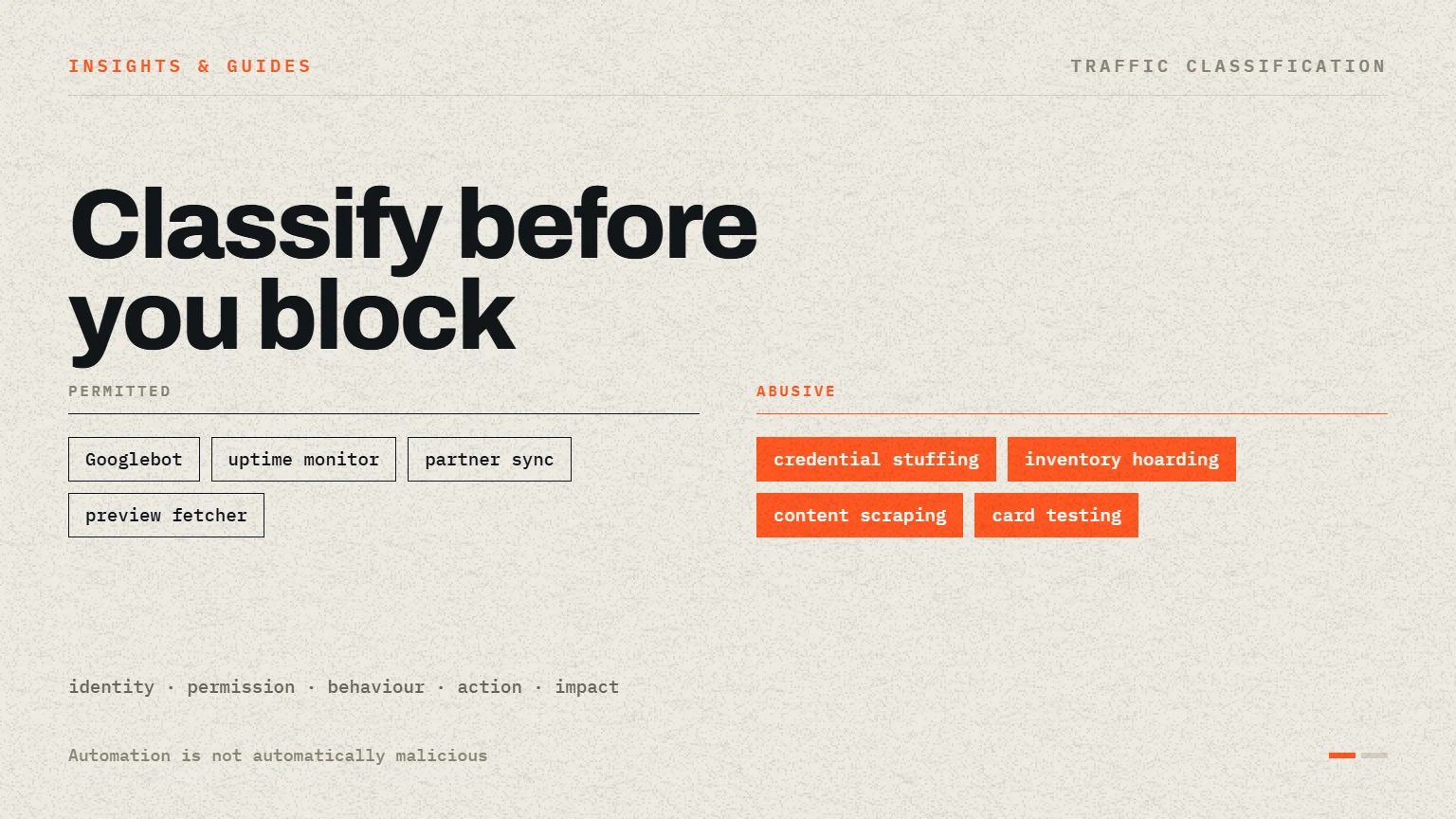
- Identify legitimate automation, including search crawlers, uptime monitoring, partner integrations, and your own scheduled jobs.
- Choose observable signals for each action instead of depending on a single global rule.
- Define allow, monitor, rate-limit, challenge, and deny outcomes before enabling enforcement.
- Record what happened so that false positives and missed abuse can be investigated.
Use multiple independent signals
No single field reliably separates every human from every bot. User-agent strings can be spoofed, residential proxy networks can distribute requests, and legitimate users can share an IP address. A stronger decision combines signals that fail in different ways.
- Network context: IP reputation, ASN, hosting or residential classification, proxy indicators, geolocation, and hostname evidence.
- Request context: URL, method, headers, parameters, missing browser conventions, and malformed or suspicious values.
- Client context: user agent, device category, browser family, and whether claimed attributes contradict other evidence.
- Behavior: request frequency, bursts, repeated failures, account fan-out, path sequence, and actions that are too regular to match normal use.
- Business policy: allowed countries, known partners, protected campaigns, customer-specific lists, and the sensitivity of the requested action.
Separate classification from the final decision
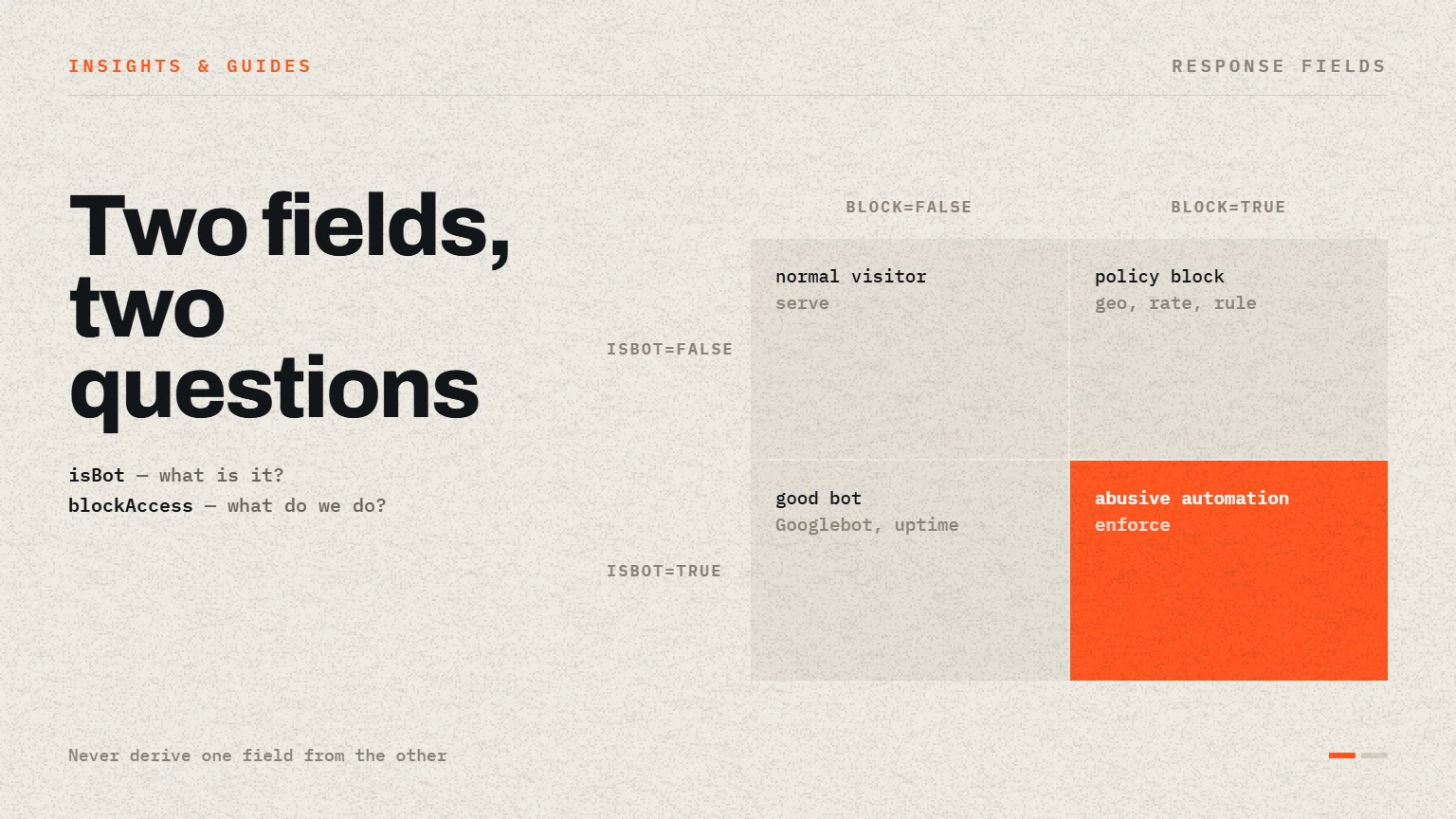
Classification answers what the request appears to be. Policy answers whether it may continue here and now. Keeping these steps separate prevents a common integration error: assuming that every bot should be blocked or that every non-bot should be allowed. A verified search crawler may be automated and allowed. A human-looking request may still be denied because it violates a country, hostname, URL threat, or customer rule.
In Stopbot responses, isBot is classification context and blockAccess is the final access decision. detectActivity explains the decision reason, while threatURL reports the submitted URL threat signal. An integration should first confirm that the API request succeeded, then use the final decision field for enforcement and retain the other fields for explanation and investigation.
{
  "isBot": 1,
  "blockAccess": 0,
  "threatURL": 0,
  "detectActivity": "[Allow] - SearchEngine (Google)",
  "pageResponseType": "None",
  "pageResponseContents": "Stay On Page"
}
Apply a graduated response
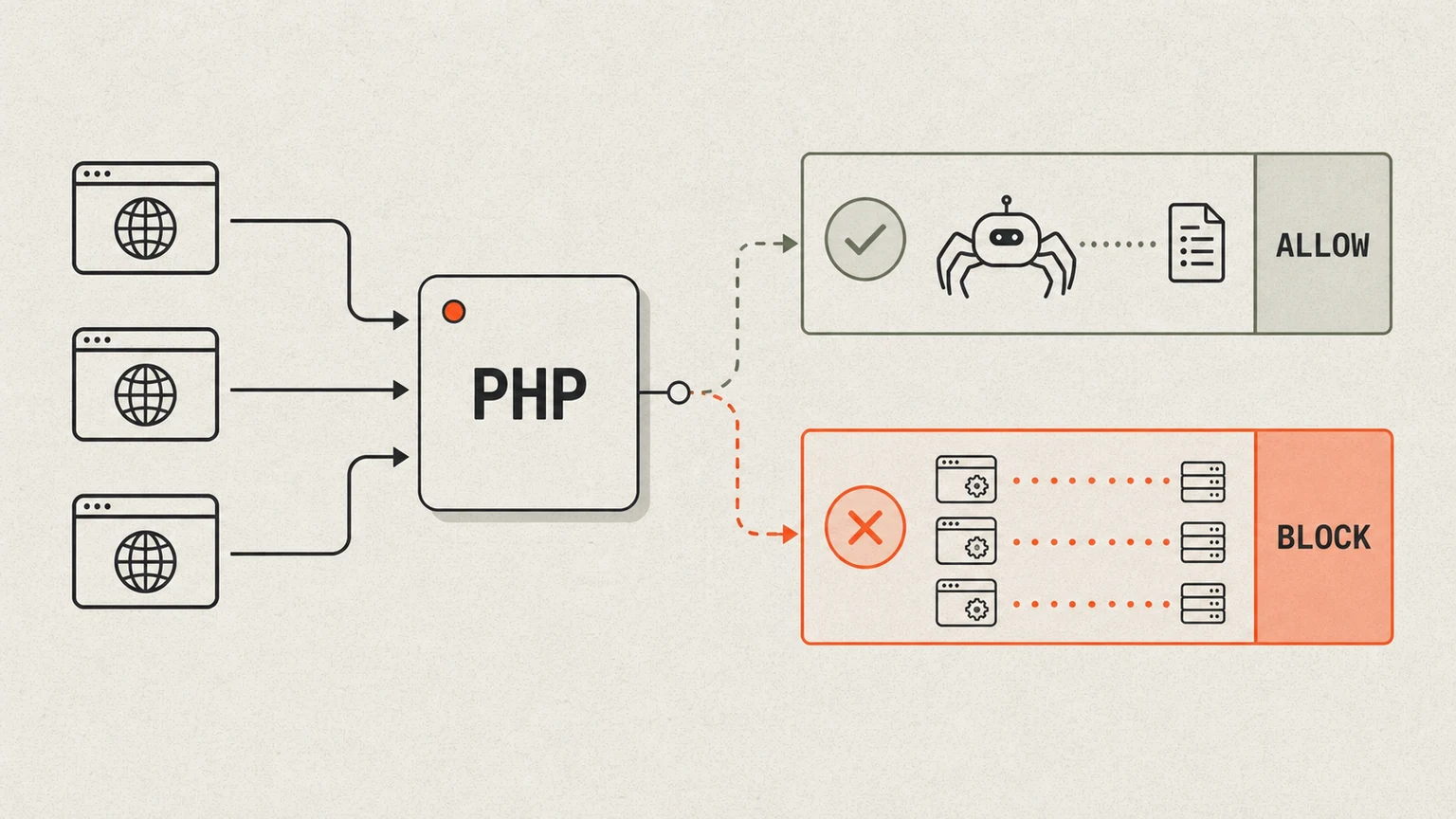
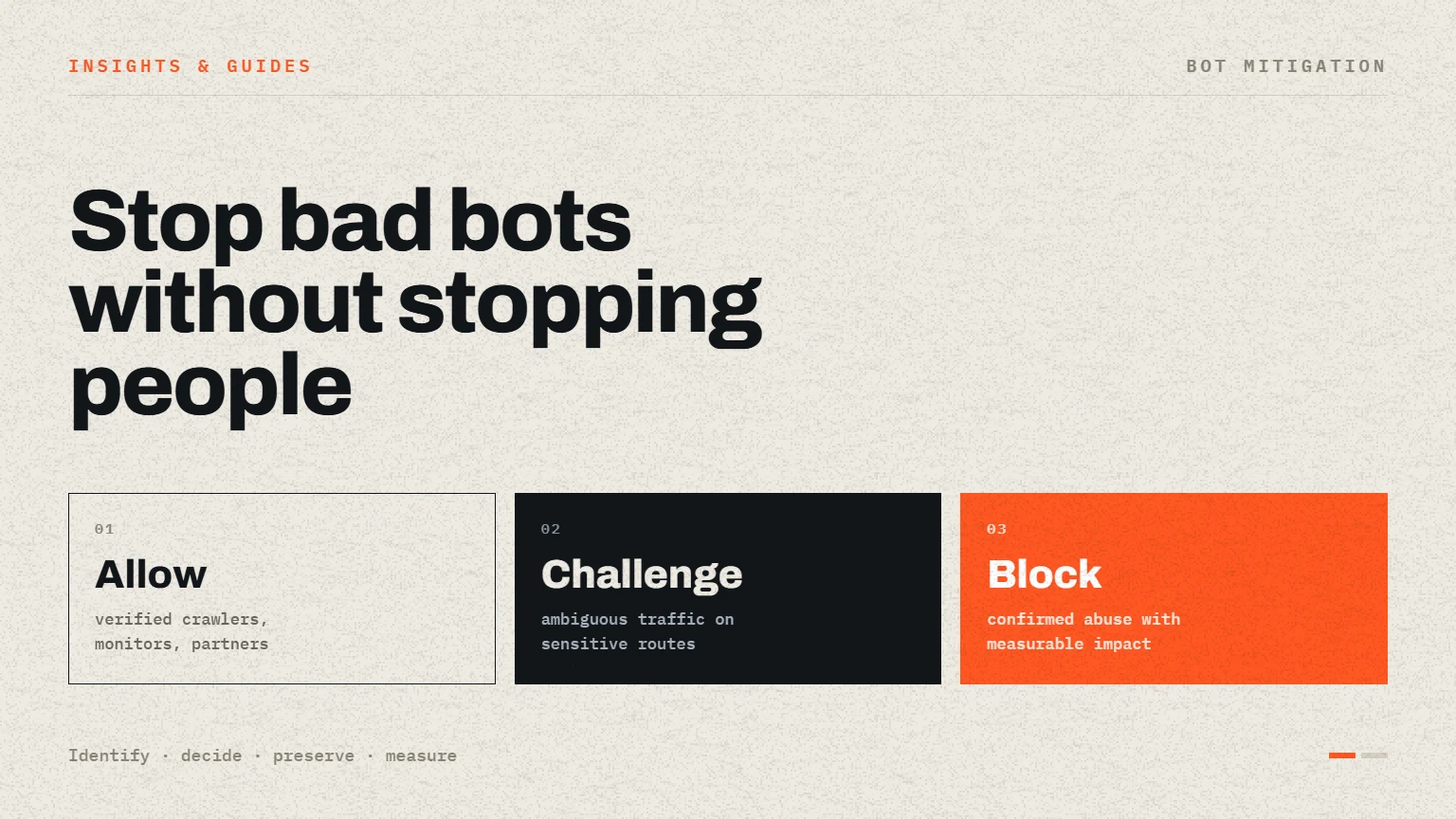
Immediate blocking is appropriate for some high-confidence threats, but it should not be the only control. A graduated response lets the system match enforcement to confidence and business impact.
- Allow verified low-risk traffic and known integrations.
- Monitor uncertain traffic while collecting enough evidence to tune policy.
- Rate-limit repetitive activity before it consumes disproportionate resources.
- Require step-up authentication or another challenge for suspicious high-value actions.
- Deny requests when policy or high-confidence threat evidence requires it.
- Use temporary mitigation where behavior can change, especially for IP-based controls.
Bot mitigation complements application security controls; it does not replace them. Login protection still needs secure password handling, multi-factor authentication, account-level controls, and careful session management. Payment and API routes still need authorization, validation, idempotency, and abuse-resistant business logic.
Roll out enforcement without locking out real users
- Run new rules in observation mode and compare decisions with known traffic.
- Test home pages, articles, login flows, checkout, APIs, uptime monitors, and search crawler access separately.
- Review allowed, blocked, and total request counts by route, country, network type, device, and reason.
- Sample both sides: blocked requests for false positives and allowed requests for missed abuse.
- Deploy the narrowest effective policy first, then expand only when evidence supports it.
- Keep a documented rollback path for every enforcement change.
Metrics that show whether mitigation works
A falling request count is not enough to prove success. Track blocked and allowed volume, decision reasons, protected-action completion, login failure patterns, challenge completion, support reports, latency, and API availability. The most important metric is the reduction of harmful outcomes without an unacceptable increase in legitimate-user failure.
Sources
Continue building
Put the decision fields into practice.
Review the current API documentation before changing production traffic handling.